NVIDIA - Hugging Face: Had France Already Lost One of Its AI Giants?
News & Insights
6 min1 min read
Three French founders, a global AI giant built in the US and a reported $12.9B deal. Hugging Face’s story raises a bigger question: can Europe scale its own champions?
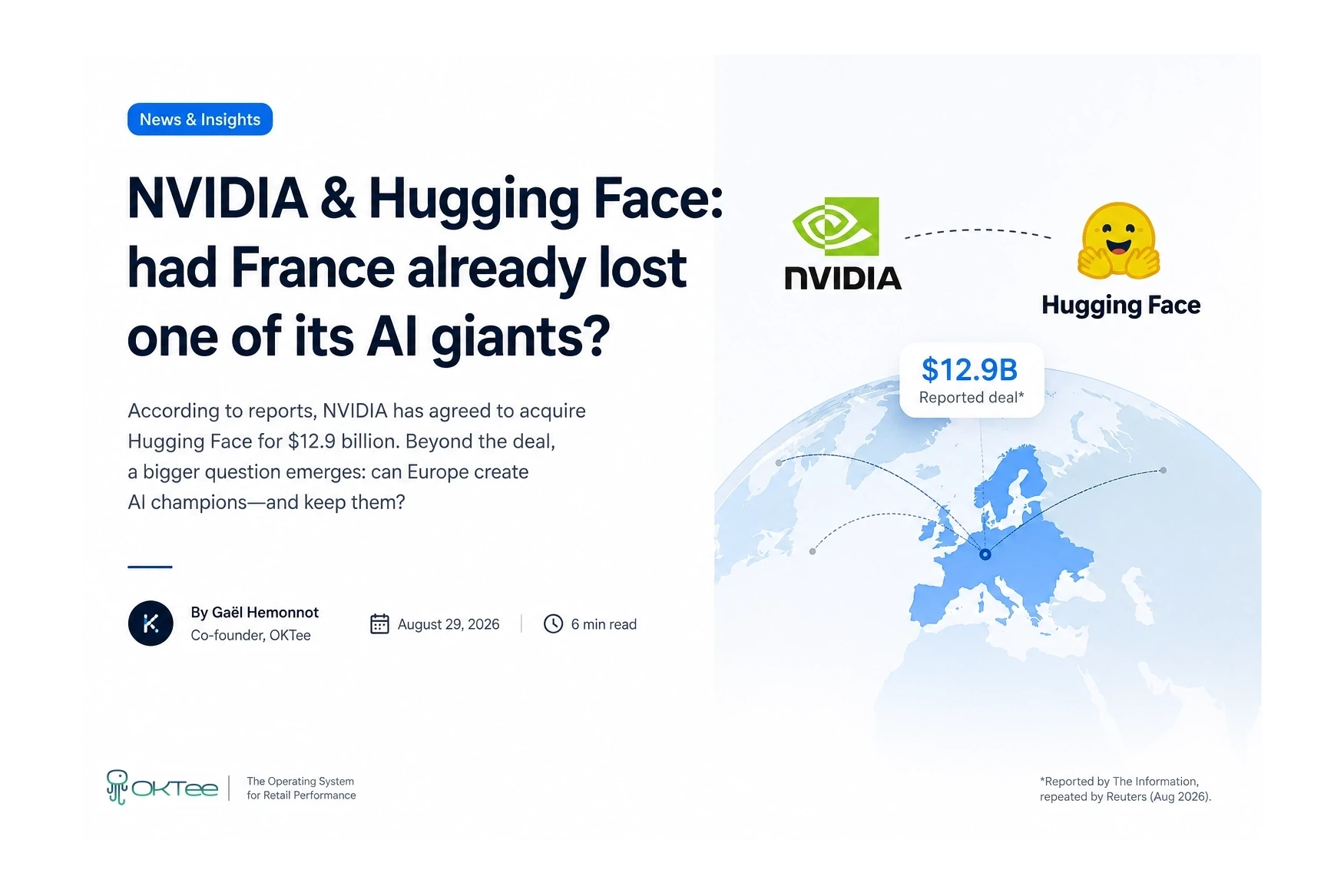
According to The Information, in a report subsequently covered by Reuters, NVIDIA has agreed to acquire Hugging Face for $12.9 billion.
At the time of writing, however, neither NVIDIA nor Hugging Face has publicly announced the transaction.
If confirmed, the deal would be significant: NVIDIA would gain control of one of the most important platforms in the global artificial intelligence ecosystem.
But from a French perspective, the story raises another question.
Hugging Face was founded by three French entrepreneurs: Clément Delangue, Julien Chaumond and Thomas Wolf.
So is France about to lose one of its AI champions? Not exactly.
In some ways, part of that story was already written ten years ago.
Three French founders, an American company
The Hugging Face story began in 2016.
Clément Delangue, Julien Chaumond and Thomas Wolf are French, and the origins of their project can be traced back to Paris. But the company soon crossed the Atlantic.
At the time, their idea was very different from the Hugging Face we know today. They wanted to build an AI-powered chatbot, a kind of virtual friend aimed particularly at teenagers.
It was an ambitious and highly experimental consumer project with no obvious path to monetisation.
The team secured an initial $200,000 investment from Betaworks and joined the US investor's startup accelerator in New York.
They then moved across the Atlantic to officially set up the company in the United States.
Years later, co-founder Julien Chaumond would explain the context very clearly: with this type of consumer project and no immediate monetisation, the founders believed they would never have been able to raise the necessary funding in France at the time.
That distinction matters. It does not mean that France was incapable of funding technology startups in 2016. But highly speculative, capital-intensive projects with immediate global ambitions were considerably more likely to find investors willing to take that risk in the United States.
From chatbot to the “GitHub of AI”
Hugging Face's original project was ultimately not what made the company successful. It gradually pivoted towards tools for AI researchers and developers.
The company developed the Transformers library and built a platform where developers and organisations could publish, share, test and use AI models, datasets and applications.
Hugging Face gradually became what is often described as the “GitHub of AI.”
The comparison is not perfect, but it illustrates the company's role.
Hugging Face does not simply develop another AI model competing with OpenAI, Anthropic, Google, Meta or Mistral.
Its platform hosts and distributes models from a huge range of organisations.
It has therefore become an important piece of infrastructure for the open and open-weight AI ecosystem.
And that is precisely what makes NVIDIA's reported interest so strategically significant.
Why $12.9 billion?
According to The Information, NVIDIA has agreed to pay $12.9 billion for Hugging Face. Reuters also reported that the company generates approximately $150 million in annualised revenue. The gap between those two numbers is striking.
But NVIDIA would clearly not be paying for Hugging Face's current revenue alone. It would primarily be paying for its position within the global AI ecosystem.
Hugging Face had already reached a $4.5 billion valuation in 2023, when it raised $235 million from investors including Salesforce, Google, Amazon, NVIDIA, AMD, Intel, Qualcomm and IBM.
In other words, many of the world's largest technology companies had already recognised the platform's strategic importance.
Why NVIDIA cares about open AI models
NVIDIA currently dominates much of the computing infrastructure used to train and run artificial intelligence models. But that position is increasingly being challenged.
Several major technology companies are developing their own AI accelerators and looking for ways to reduce their dependence on NVIDIA GPUs.
According to The Information, this is part of the strategic rationale behind the Hugging Face acquisition.
NVIDIA has an interest in seeing a broad ecosystem of open models developed by thousands of independent companies continue to grow.
Why?
Because those companies all need computing infrastructure to train and run their models.
And NVIDIA obviously intends to remain at the centre of that infrastructure.
Acquiring Hugging Face would bring NVIDIA considerably closer to developers, models and their deployment.
It would be a logical extension of its strategy: moving beyond being one of AI's essential computing providers and occupying more of the software ecosystem surrounding it.
So, is France losing Hugging Face in 2026?
This may be the most interesting question raised by the story.
Simply saying that “France is losing Hugging Face” would be misleading.
Hugging Face has been legally and economically an American company since its early days.
Its headquarters are in New York, even though the company has maintained a significant presence in France and employs many French and European AI specialists.
The more interesting question is:
How did three French entrepreneurs end up building in the United States what would become one of the world's most important AI companies?
Part of the answer lies in the environment of 2016.
The United States had a depth of venture capital, a culture of funding highly speculative projects and a technology ecosystem that Europe struggled to match.
For Hugging Face's founders, access to Betaworks and US investors played a concrete role in getting the company started.
Ten years later, France has changed
It would be equally misleading to suggest that France's technology ecosystem has remained unchanged.
It hasn't. Investment in artificial intelligence has increased significantly.
Paris has become one of Europe's major AI hubs. New global contenders have emerged. Mistral AI is perhaps the clearest example.
Founded in France in 2023, the company reached a valuation of more than €10 billion within just a few years and is now developing models, infrastructure and computing capabilities in Europe.
A trajectory like this would have been much harder to imagine within the French ecosystem of 2016.
France and Europe have clearly made progress.
But the Hugging Face story also highlights how much remains to be done.
Creating champions is not enough. They need room to scale.
Europe has world-class researchers. It produces excellent engineers. And it has entrepreneurs capable of building global technology companies. Talent is therefore only part of the equation.
The other challenge is scale. Building a global technology company can require billions of euros in capital, enormous computing resources, rapid access to international markets and investors willing to tolerate years of uncertainty.
Europe's ability to support companies through that stage remains one of the most important differences between the European and US technology ecosystems.
So the question is no longer simply:
“Can we create the next Hugging Face?”
We already know that we can. The more important question is:
“If we create the next Hugging Face, will we have the resources to scale it globally from Europe?”
This battle extends far beyond the tech industry
The issue is not limited to companies developing artificial intelligence. AI infrastructure will increasingly reshape almost every industry. Commerce is one of them.
Conversational product discovery, recommendations, content generation, data analysis, operational automation and AI agents capable of assisting, or even completing, purchases are gradually entering every layer of digital commerce. Behind these applications are models.
Behind those models is infrastructure.
And behind that infrastructure are now a handful of companies capable of investing tens of billions of dollars. The potential NVIDIA–Hugging Face deal illustrates this battle particularly well. Competition in artificial intelligence is no longer simply about who has the best model.
It is increasingly about who controls the infrastructure, tools, platforms and ecosystems on which future applications will be built.
The real lesson from Hugging Face
The Hugging Face story can ultimately inspire both pride and frustration.
Three French entrepreneurs built one of the most important pieces of infrastructure in the global artificial intelligence ecosystem. That is another demonstration of the quality of talent coming out of France and Europe.
But their journey is also a reminder: Talent alone is not enough.
You also need an environment capable of turning an excellent idea into a global company.
France and Europe are investing far more heavily in artificial intelligence today than they were ten years ago. That is one of the most encouraging developments of recent years.
The challenge now is to prove that Europe can not only produce the next generation of global technology champions… but also give them the resources to become global while remaining European.
Editor's note — August 29, 2026: The Information reports that NVIDIA has agreed to acquire Hugging Face for $12.9 billion, an account subsequently reported by Reuters. At the time of publication, NVIDIA and Hugging Face had not publicly announced the completion of the transaction.
Related Products